DSS: Redefining Biotechnology & Life Science in India
































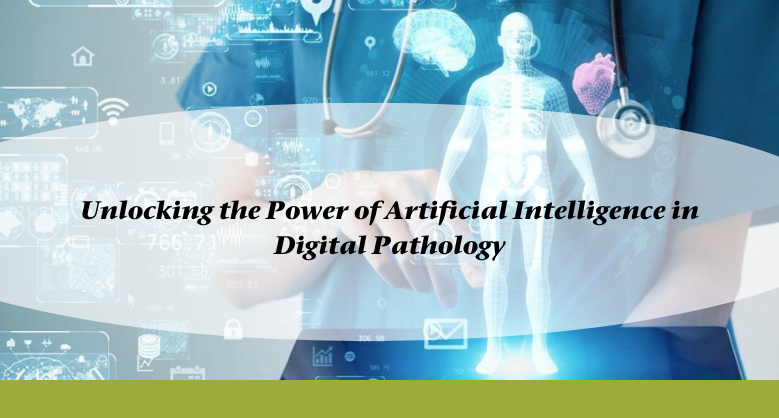
Unlocking the Power of Artificial Intelligence in Digital Pathology
Unlocking the Power of Artificial Intelligence in Digital Pathology
Digital pathology has emerged as a promising technology that enables pathologists to examine and interpret samples remotely, making the diagnostic process faster, more accurate, and more accessible. Ho
wever it gets harder to effectively analyze the data as it grows in complexity and volume as a result of digital pathology. Fortunately, the development of artificial intelligence (AI) is revolutionizing the field of digital pathology and enabling it to reach its full potential for both patients and medical professionals.
This blog explores how AI is transforming digital pathology in a variety of ways, including increased precision and effectiveness, revealing hidden patterns, and optimizing workflow.
The Intersection of Artificial Intelligence and Digital Pathology
Digital pathology and artificial intelligence (AI) together constitute a potent synergy that can transform diagnosis. With its massive collections of digitalized medical pictures and slide collections, digital pathology offers an enormous quantity of data that is just ready to be used. Deep learning and machine learning approaches enable AI computers to analyze this data with unparalleled speed and precision. They can distinguish between different cell kinds, recognize subtle patterns, and even forecast the course of diseases.
The use of AI in Microscope pathology has the potential to improve patient outcomes, increase diagnostic accuracy, and change how illnesses are identified, comprehended, and treated. It allows pathologists to use clever algorithms as useful diagnostic aids, ultimately resulting in more accurate and effective healthcare delivery.
How AI Algorithms Augment Pathological Diagnosis
Pathological diagnosis might be considerably improved by AI algorithms in a number of ways. The following are some significant ways that AI algorithms may help and improve the diagnostic process:
Decision Support: AI algorithms can be useful tools for pathologists who need to make decisions. They can offer more details, comments, and numerical measures to help with the analysis of pathology pictures. AI algorithms may suggest probable diagnoses, give differential diagnoses, and provide insights that aid pathologists in their decision-making by analyzing big datasets and incorporating clinical data.
Speedy Diagnosis: Pathologists must frequently analyze a large number of slides in order to make a pathological diagnosis, which takes time. By proactively screening and pre-analyzing slides, indicating possibly odd regions, and giving priority to urgent situations, AI systems can speed up this process. This facilitates pathologists’ workload reduction and enables them to concentrate their knowledge on situations that demand closer scrutiny, leading to quicker diagnosis and prompt treatment choices.
Standardization and Consistency: Differences in how pathology slides are interpreted by humans can be attributed to a variety of subjective variables, degrees of experience, and even weariness. Because they offer an objective analysis that is unaffected by individual variations, AI algorithms have the potential to standardize and consistently diagnose patients. Particularly in tough instances when unanimity among pathologists may be challenging to establish, this can result in more trustworthy and reproducible outcomes.
Enhanced Accuracy: AI algorithms are very precise and consistent in their analysis of enormous quantities of digital pathology pictures. AI systems may continually improve their performance, learn from data, and make increasingly accurate diagnostic predictions by utilizing machine learning techniques.
Ethical and Regulatory Considerations in AI-Based Pathology
Although integrating artificial intelligence (AI) into pathology has many advantages, responsible and ethical use also requires careful consideration of the legal and ethical issues involved. Listed below are some crucial things to remember:
- Informed Consent and data usage: Patient consent is essential in AI-based pathology, as are informed consent and data usage. Organizations and researchers must make sure that patients are informed about the possible hazards and advantages of using their data in AI algorithms as well as their ability to withdraw consent or opt-out. Transparency in data utilization promotes confidence and equips patients to make wise choices by providing comprehensive explanations of how AI algorithms work and the consequences for diagnosis and therapy.
- Validation and Regulatory Oversight: Before using AI algorithms in clinical settings, rigorous validation is essential. The performance, safety, and effectiveness of AI-based pathology systems must be assessed according to rules and criteria that must be established by regulatory agencies and professional organizations. To maintain adherence to these criteria and reduce any dangers connected with the deployment of AI algorithms, ongoing monitoring, and regulatory control should be in place.
- Fairness and Bias: If AI systems are taught on datasets that are biased or lack diversity, they may become biased themselves. It is essential to provide comprehensive and representative statistics that include a range of demographics, ethnicities, and socioeconomic backgrounds in order to prevent the perpetuation of inequities in healthcare.
- Patient privacy and data security: These are important considerations since AI algorithms use a significant quantity of patient data, including clinical data and related medical pictures. To ensure confidentiality, it’s critical to respect stringent privacy regulations, making sure that patient data is anonymized and stored securely. The importance of adhering to data protection laws such as GDPR (General Data Protection Regulation) in the European Union and HIPAA (Health Insurance Portability and Accountability Act) in the United States cannot be overstated.
Real-Life Examples of AI Applications in Digital Pathology
The practical effects of this technology on diagnostic capacities and patient care are progressively being demonstrated through real-world instances of AI applications in digital pathology. For instance, AI models trained on huge datasets have demonstrated equivalent or even higher accuracy to human pathologists in identifying malignancies on digitalized histopathology slides for breast cancer detection.
AI models can evaluate biopsy slides for prostate cancer and forecast the risk of disease progression or recurrence, which helps with treatment choices and follow-up procedures.
AI algorithms may help pathologists grade tumors, which is a crucial step in figuring out how aggressive a disease is and informing treatment choices. AI algorithms can give objective and standardized grading evaluations by examining variables including tumor shape, nuclear properties, and cellular proliferation rates. This helps with prognostic forecasts and individualized treatment planning.
Embracing the Promise of AI for Advancements in Digital Pathology
In the field of digital pathology diagnostics, artificial intelligence (AI) is emerging as a game-changer, ushering in a new age of extraordinary developments and opportunities. We may realize AI’s transformational promise and completely alter the way illnesses are identified, comprehended, and treated by incorporating AI algorithms into pathology practice. The potential of AI in digital pathology resides in its capacity to improve diagnostic precision, expedite processes, unearth untapped knowledge, and enable more individualized and efficient patient treatment.
It is crucial to keep up a proactive attitude toward learning, adjusting, and improving AI algorithms as we set out on this exploratory voyage. The ethical integration of AI into pathology practices will benefit from ongoing research, validation, and adherence to ethical standards, maximizing its potential for development while emphasizing patient safety and well-being.
Latest Articles

International Women’s Day – Prioritising Women’s Health for a Healthier...
BY Ms. Sohini Chatterjee, Application Specialist, DSS Imagetech 7th March 2026
In 2013, one public disclosure transformed the global conversation around women’s health. When Angelina Jolie revealed in a New York Times op-ed that she carried a BRCA1 mutation and had...
Read More
How BX51WI Microscopes Support High-Resolution Neural Imaging
BY DSS Imagetech Pvt Ltd 24th February 2026
Picture this scenario. It’s 6:00 PM on a Friday. You have spent the last six hours harvesting tissue. You perfused the mouse perfectly, the liver cleared instantly, and the brain...
Read More
The Role of Research & Development in Driving Scientific Innovation
BY DSS Imagetech Pvt Ltd 24th February 2026
Human progress is not an accident. The leap from a simple medicinal herb to a targeted biologic drug, from a magnifying glass to a digital microscope, or from a basic...
Read More