DSS: Redefining Biotechnology & Life Science in India






























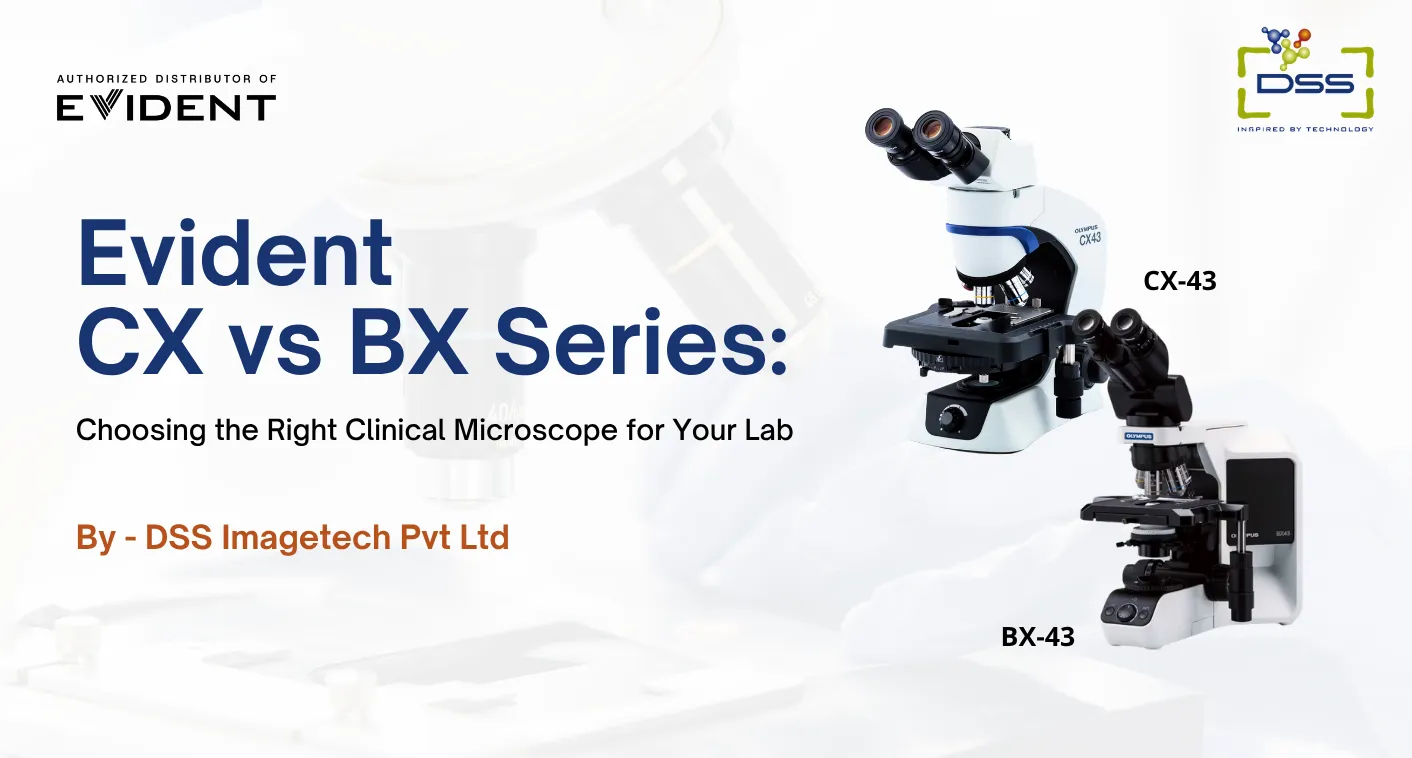
Evident CX vs BX Series: Choosing the Right Clinical Microscope for Your Lab
Forget the spec sheets for a second. Think about your back at 4:00 PM on a Tuesday. Think about that one slide with the confusing cell structure that you’ve been staring at for twenty minutes, wondering if the “fuzziness” is the sample or just your tired eyes.
In the high-stakes world of Indian diagnostics, your microscope is your primary weapon. But even the best soldiers need to know whether they are carrying a reliable sidearm or a heavy-duty artillery piece. If you are looking at the Evident CX23 and the Evident BX53, you aren’t just looking at two different price tags on a shelf, you are looking at two entirely different ways of running a lab.
Choosing between these two is the most significant decision you’ll make for your bench this year. One is a compact “workhorse” designed to survive the chaos of a high-volume screening center. At the same time, the other is a modular “brain” capable of solving the most complex pathological mysteries. Let’s strip away the marketing jargon and talk about how these machines actually perform in the heat, dust, and pressure of a real Indian clinical environment.
The Core Difference: Routine vs. Revelation
The first thing you need to realize is that Evident (formerly the legendary Olympus brand) didn’t build these to compete with one another. They built them to solve different problems.
The Evident CX23 is built for speed and survival. It’s the microscope you want when you have 50 blood smears waiting and a line of patients outside. It’s fixed, it’s sturdy, and it doesn’t ask for much. It is the definition of “essential excellence.”
The Evident BX53 is built for discovery and depth. This is the microscope for the pathologist who needs to see the exact shade of a nucleus or the subtle flare of a fluorescent marker. It doesn’t just show you the slide; it gives you the tools to analyze it from every possible angle. It is a research-grade instrument adapted for the clinical frontline.
Optical Clarity—The Battle of the Lenses
In microscopy, the glass is the soul of the machine. If the lenses aren’t right, the best LED in the world won’t save your diagnosis. In India, where we deal with a massive variety of tropical diseases and complex malignancies, optical clarity isn’t a “feature”, it is a necessity.
The CX23: The King of Consistency
The Evident CX23 utilizes what we call “plan achromat” objectives. In the context of a busy Indian lab, “Plan” is a very important word. It means the image is flat. On a cheap, basic microscope, you might find that when the center of the slide is in focus, the edges are blurry. This forces your eyes to constantly “refocus” as you move the slide.
- The Field Number (FN) 20: The CX23 gives you a wide “porthole” to look through. By providing a Field Number of 20, it allows you to see more of the sample at once compared to entry-level scopes (which usually offer FN 18).
- The Clinical Benefit: For routine malaria or TB screening, this wide, flat view allows you to scan the slide faster. It’s about throughput without the “eye-strain” tax. It is the perfect balance for a technician who needs to stay productive for an eight-hour shift.
The BX53: High-Definition Pathology
When you move to the BX53, you aren’t just getting “good” glass; you’re getting the famous X Line™ objectives.
- Resolution and Light: These lenses are designed to pull in more light and offer a higher “numerical aperture.” This means the transition between a cell wall and its surroundings is razor-sharp.
- Color Fidelity: Have you ever noticed how some LEDs make your H&E stains look “bluish” or “cold”? The BX53 uses a specialized LED that mimics natural halogen light. For a pathologist, this is critical. If the “pink” of your eosin looks off, your brain has to work harder to interpret the tissue. The BX53 removes that mental hurdle. It brings the “true color” of the biopsy to your eyes.
Ergonomics—Fighting the “Microscopist’s Neck”
Let’s talk about “Microscopist’s Neck.” It’s a real occupational hazard in Indian labs where the workload is relentless. If your microscope isn’t adjusted to your body, your body will pay the price in the form of chronic back pain and repetitive strain injuries.
The CX23: Small, Sturdy, and Smart
The CX23 is surprisingly light, weighing in at just under 6 kg. It has built-in molded handles, which is a godsend if you need to move equipment around in a cramped space or store it in a cabinet at the end of the day.
- Low-Positioned Controls: The knobs you use to move the slide (the stage) and the focus knobs are placed very low on the body. This means your arm stays flat on the table. You aren’t “lifting” your shoulder or tensing your neck every time you move the slide.
- Fixed Angle: The eyepieces are at a 30-degree angle. For most people, this is a “Goldilocks” position: not too high, not too low. It’s built for the average user to stay comfortable without needing constant adjustments.
The BX53: The Customizable Command Center
The BX53 takes ergonomics to a professional level. It recognizes that one size does not fit all.
- The Tilting Head: This is the game-changer. You can actually change the angle and the “reach” of the eyepieces. If you are tall, or if you prefer to sit back further from the bench, the microscope adjusts to you, rather than you hunching over to fit the microscope.
- Effortless Movement: The tension on the focus knobs can be adjusted. You can make it as “stiff” or as “smooth” as you like. When you are doing “fine-focusing” on 100x oil immersion for hours, this level of customization prevents hand cramps. It makes the microscope feel like a part of your own body.
Modularity—A Bridge to the Future
This is the biggest fork in the road for any lab owner considering the clinical microscope price in India. You have to ask yourself: What will my lab be doing three years from now?
The CX23: The Specialized Workhorse
Think of the CX23 as a high-quality “point-and-shoot” camera. It does Brightfield (standard stained slides) perfectly. You can’t really add fluorescence to it, and you can’t turn it into a multi-head teaching system.
- The Strength of Simplicity: Because it’s not modular, fewer parts can break, shake loose, or get dusty. In the dusty environment of many Indian cities, the “sealed” and integrated nature of the CX23 is a massive advantage for longevity. It is a “buy it once, use it forever” kind of machine for routine work.
The BX53: The System that Grows
The BX53 is a “modular” system. It’s like a high-end DSLR camera where you can swap lenses, flashes, and sensors.
- Fluorescence: If your lab decides to start doing advanced TB testing (auramine) or immunology (ANA patterns), you don’t need to buy a new microscope. You just add a fluorescence module to your BX53.
- Teaching Heads: If you are running a teaching hospital or a residency program, you can add “side heads.” This allows five or even ten doctors to look at the same slide at the same time with perfect clarity.
- Digital Integration: While both can take cameras, the BX53 is designed to talk to advanced imaging software. It can “remember” your light settings for each objective, making your digital pathology reports look professional and consistent every single time.
The “Dust and Heat” Factor—Maintenance in India
We have to be honest about our environment. A lab in Delhi, Chennai, or Kolkata is not the same as a lab in a climate-controlled building in Europe. We deal with high humidity, fine tropical dust, and unpredictable power fluctuations.
The CX23: The Rugged Survivor
The Evident CX23 is built for these conditions.
- LED Longevity: Its LED light source is rated for 20,000 hours. That is roughly 10 to 12 years of work without ever having to change a bulb. This is a huge relief in areas where spare parts might take a week to arrive.
- Dust Resistance: Its eyepieces are “fixed” in place, and the nosepiece (where the lenses are) faces inward. This reduces the amount of glass exposed to the air. It’s a design that respects the reality of a busy, non-AC environment.
The BX53: The High-Maintenance High-Performer
The BX53, because it has more moving parts and “gaps” where modules fit together, requires a bit more care.
- Environment: You really want this machine in a climate-controlled (AC) room with a dedicated dust cover.
- The “Garage” Rule: It is a “high-performance vehicle,” and it needs a clean garage. If you invest in a BX53, budget for a high-quality stabilizer and a strict weekly cleaning schedule to keep the advanced optical coatings free from fungi.
Business Logic—Pricing and ROI in India
When you look at the clinical microscope price in India, the CX23 is the “value leader.” It allows a startup lab or a growing diagnostic center to offer world-class results without a “prestige” price tag that breaks the bank.
The BX53 is a significant capital investment. It can cost three to five times as much as a CX23, depending on how you “spec” it out.
The Spiky Point of View: Many lab owners in India over-buy. They buy a BX53 because they like the “idea” of modularity, but then they only ever use it for routine blood smears. That is like buying a Ferrari to drive in peak Bengaluru traffic. It’s a waste of capital.
However, if you are a pathologist and your name and reputation are on the line for complex cancer biopsies or fine-needle aspirations, the BX53 isn’t a luxury. It is a tool that gives you the confidence to sign that report. It pays for itself by reducing “reruns” and increasing your diagnostic certainty.
The Digital Shift—Tele-pathology Readiness
In 2026, the Indian diagnostic landscape is moving toward the cloud. More labs are sending images to city-based experts for “second opinions.” How do these two series handle the digital world?
CX23 Digital Workflow
The CX23 can be fitted with a “trinocular” head (a third port for a camera). It’s great for taking photos for records or showing a patient their sample. However, because the light settings are manual, your photos might vary in brightness as you switch objectives. It’s a “manual” digital experience.
BX53 Digital Workflow
The BX53 is a digital native. You can equip it with a motorized nosepiece that communicates with the camera software. When you switch from 10x to 100x, the software knows. It adjusts the white balance and the scale bar automatically. If you are planning to do telepathology or use AI-based cell counting, the BX53 provides the “clean” data these systems need to work accurately.
The “Teaching” Factor
India is currently the global hub for medical education. If you are in an academic setting, the choice is clear.
The CX23 is the perfect student microscope. It’s hard to break, easy to carry, and gives the student a great first impression of what a “real” microscope should look like. It builds good habits.
The BX53, however, is the “professor’s tool.” Multi-head attachments allow a senior pathologist to point out the specific features of a rare malignancy to a group of five residents in real-time. You cannot put a price on that kind of “shoulder-to-shoulder” learning. If your mission involves training the next generation of Indian doctors, the BX53 is your centerpiece.
Counter-Arguments—The “Third Way”
I am a strong advocate for Evident (formerly Olympus), but let’s be candid. Are there times when neither is the right fit?
- The Ultra-Budget Clinic: If you are a tiny clinic in a very remote area with almost no budget, you might look at local Indian brands. While the optics won’t be as sharp, and your eyes will tire faster, the initial cost is much lower. But remember: a microscope is a 15-year investment. Saving ₹50,000 today might cost you in diagnostic errors later.
- The All-Digital Lab: Some labs are moving to “slide scanners” where they never look through an eyepiece at all. In that case, you don’t need the ergonomic features of either series; you need a high-speed scanning robot.
The Final Breakdown
| Feature | Evident CX23 | Evident BX53 |
|---|---|---|
| Philosophy | “Fixed & Reliable” | “Modular & Powerful” |
| Best For | Routine Screening, TB, Malaria | Histopathology, Oncology, Research |
| Optical Tier | Plan Achromat (Flat field) | X Line (Highest Resolution/Color) |
| Field Number | FN 20 | FN 22 (Extra Wide) |
| Durability | High (Integrated design) | High (But requires AC/Dust care) |
| Fluorescence | No | Yes (Excellent) |
| Teaching Head | No | Yes (Up to 26 users) |
| Weight | ~5.9 kg (Very portable) | ~15 kg+ (Stationary) |
| Indian Price Point | Entry to Mid-Range | Premium Investment |
Final Verdict: The Bridge Between You and the Diagnosis
Choosing between the Evident CX23 and the Evident BX53 is about defining the soul of your laboratory.
The Evident CX23 is for the lab that is the “Frontline Defender.” It is for the facility that handles the massive volumes of routine tests that keep India healthy. It is sharp, it is honest, and it is incredibly tough. It is the best “routine” microscope your money can buy in 2026.
The Evident BX53 is for the lab that is the “expert’s expert.” It is for the pathologist who refuses to compromise on a single pixel of resolution. It is for the facility that wants a system that can evolve from a simple brightfield scope into a fluorescence powerhouse or a digital teaching hub.
A microscope is the most intimate piece of technology a doctor owns. You spend more time looking through those eyepieces than you do looking at your phone or your car’s dashboard. Don’t just buy a “piece of equipment.” Buy the vision that matches your clinical ambition.
FAQ’s :-
1. Which microscope is better for routine diagnostic labs: Evident CX23 or BX53?
The Evident CX23 is better suited for routine diagnostic laboratories handling high-volume screening like malaria, TB, and blood smear analysis. It is compact, durable, and designed for daily clinical workflows.
2. Is the Evident BX53 suitable for histopathology and cancer diagnostics?
Yes, the Evident BX53 is ideal for histopathology, oncology, and advanced pathology applications. Its X Line™ optics deliver superior resolution, color accuracy, and fluorescence compatibility for complex tissue analysis.
3. Does the Evident CX23 support fluorescence microscopy?
No, the Evident CX23 is primarily a brightfield clinical microscope and does not support fluorescence modules. Laboratories requiring fluorescence imaging should consider the BX53 series.
4. Which microscope is better for digital pathology and telepathology?
The Evident BX53 is better for digital pathology because it supports advanced camera integration, motorized components, and AI-ready imaging workflows for telepathology and remote diagnostics.
5. Why is the Evident BX53 more expensive than the CX23?
The BX53 offers premium features such as modular upgrades, advanced ergonomics, fluorescence support, teaching attachments, and higher optical performance, making it a larger long-term investment for specialized labs.
6. Which microscope is easier to maintain in Indian laboratory conditions?
The Evident CX23 is easier to maintain due to its rugged integrated design, dust resistance, and low-maintenance LED illumination, making it highly reliable for Indian laboratory environments.
Latest Articles
Evident CX vs BX Series: Choosing the Right Clinical Microscope...
BY DSS Imagetech Pvt Ltd 27th May 2026
Forget the spec sheets for a second. Think about your back at 4:00 PM on a Tuesday. Think about that one slide with the confusing cell structure that you’ve been...
Read More
LUNG CANCER CARE: THE POWER OF PRECISION DIAGNOSTICS & GENOMICS
BY Mr. Jaywant Chauhan, Application & Product Specialist, DSS Imagetech 19th May 2026
Lung cancer today is among the most common & serious types of cancer in the world. It happens when abnormal cells in the lungs begin to grow in a way...
Read More
How Digital Karyotyping Software Supports Prenatal Genetic Testing
BY DSS Imagetech Pvt Ltd 30th April 2026
It is a Tuesday morning. A couple is sitting in an OB-GYN office, holding hands so tightly their knuckles are white. They aren’t looking at their phones. They are staring...
Read More