DSS: Redefining Biotechnology & Life Science in India






























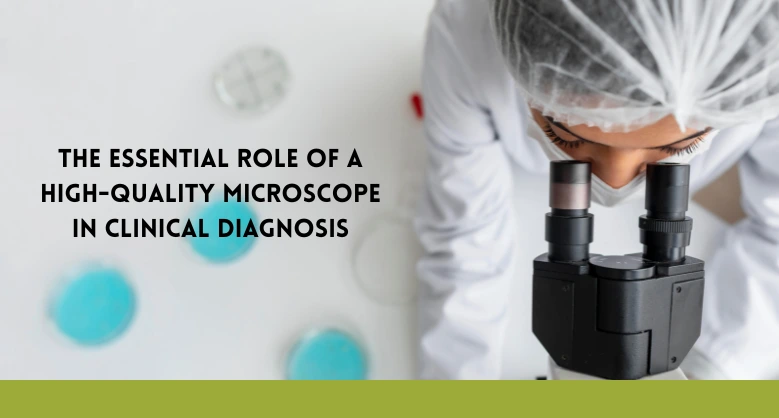
The Essential Role of a High-Quality Microscope in Clinical Diagnosis
Microscopy has long been an indispensable tool in clinical diagnosis, enabling visualization of cells, tissues, and microorganisms that cannot be seen with the naked eye. The accuracy and reliability of diagnostic outcomes often depend on the quality of the microscope used. A high-quality microscope ensures superior image clarity, resolution, contrast, and durability—features critical for identifying subtle pathological changes. This paper explores the role of a good quality microscope in clinical diagnostics, emphasizing its impact on patient care, laboratory efficiency, and advancements in medical science.
1.Introduction
In the realm of clinical diagnostics, precise and early detection of diseases is vital. Microscopes serve as the frontline instrument in laboratories for examining blood smears, urine samples, tissue biopsies, and microbial cultures. The effectiveness of such examinations hinges largely on the optical and mechanical quality of the microscope. A compromised instrument can lead to diagnostic errors, affecting treatment and patient outcomes.
2. Importance of Microscopy in Clinical Settings
Microscopy is fundamental in:
- Hematology: Differentiation of white blood cells, detection of anemia, leukemias, and malaria parasites.
- Histopathology: Examining tissue architecture for cancer, inflammation, or degenerative changes.
- Microbiology: Identification of bacteria, fungi, and protozoa in clinical samples.
- Cytology: Pap smear evaluations, fine-needle aspiration biopsies.
- Parasitology: Detecting parasitic infections in stool, blood, or tissues.
- Urinalysis: Microscopic detection of crystals, cells, casts, and microorganisms
Each of these applications demands precision in observation, which can only be achieved through a high-quality microscope.
3. Characteristics of a Good Quality Microscope in Clinical Diagnosis
i. High Optical Resolution
- Enables clear differentiation of minute cellular structures.
- Vital for identifying subtle abnormalities in blood smears, tissue sections, and microbial samples.
- Objectives with higher numerical apertures (N.A.) provide superior resolving power.
ii. Consistent and Adjustable Illumination
- LED or halogen light sources with adjustable intensity provide optimal illumination under various conditions.
- Koehler illumination enhances contrast and uniformity across the field of view.
- Uniform lighting reduces eye strain and improves reproducibility.
iii. Excellent Contrast Mechanisms
- Phase contrast, DIC (Differential Interference Contrast), and polarization capabilities improve visibility of transparent specimens.
- Fluorescence compatibility is essential for advanced diagnostic applications (e.g., tuberculosis, cancer markers, autoimmunity).
iv. Ergonomic Design
- Comfortable eyepieces, adjustable viewing angles, and user-friendly stage controls reduce operator fatigue.
- Smooth mechanical stage movement and coarse/fine focus knobs enhance precision during prolonged use.
v. Durability and Stability
- Sturdy mechanical construction ensures long-term use without frequent calibration or breakdowns.
- Anti-fungal coatings and dust-proof enclosures help maintain optical clarity in diverse environments.
vi. High-Quality Objectives and Eyepieces
- Plan Achromatic, Semi-Apo, or Plan Apochromatic objectives minimize chromatic and spherical aberrations.
- Wide field eyepieces having FN 20 or more allow better field coverage and ease of sample navigation.
vii. Digital Imaging Compatibility
- Built-in or attachable digital cameras for image capture, analysis, and documentation.
- Integration with image analysis software and hospital or laboratory information systems (LIS/HIS).
viii. Easy Maintenance and Calibration
- Modular design for easy cleaning and replacement of parts.
- Availability of service support and replacement components enhances longevity.
ix. Modular and Upgradable
- Flexibility to add fluorescence, polarizers, camera ports, and other modules as diagnostic needs evolve.
- Enables expansion from basic clinical use to advanced research or teaching applications.
x. Regulatory and Quality Compliance
- Must comply with ISO/CE/FDA certifications for medical equipment.
- Ensures safety, reliability, and reproducibility in clinical environments.
4. Consequences of Using Poor Quality Microscopes
- Misdiagnosis: Inability to detect subtle abnormalities, leading to false positives/negatives.
- Delayed Diagnosis: Repeated examinations due to unclear results delay treatment.
- Operator Fatigue and Eye Strain: Increases the risk of human error.
- Lack of Reproducibility: Inconsistent findings compromise the credibility of test results.
- Increased Costs: Frequent repairs or replacements, poor workflow efficiency.
5. Technological Advancements
Modern microscopy innovations such as digital slide scanning, AI-powered image analysis, and remote consultations depend entirely on the quality and compatibility of the base microscope. Integration with hospital information systems (HIS) also facilitates better record-keeping and research.
6. Conclusion
A good quality microscope is not a luxury but a necessity in clinical laboratories. It ensures diagnostic accuracy, efficiency, and long-term cost-effectiveness. Investing in superior microscopy not only improves patient care but also enhances the credibility of diagnostic laboratories and supports medical research. Healthcare institutions must prioritize quality instrumentation in their diagnostic workflows.
7. References:
- World Health Organization (WHO). “Microscopy for Detection of Tuberculosis and Malaria.”
- Bancroft JD, Gamble M. Theory and Practice of Histological Techniques.
- Cheesbrough M. District Laboratory Practice in Tropical Countries.
- Clinical Laboratory Standards Institute (CLSI) Guidelines.
- Olympus Life Sciences. Whitepapers and technical brochures.
Faq’s :-
1. Why is a high-quality microscope important in clinical diagnostics?
A high-quality microscope ensures clear, accurate, and detailed visualization of cells, tissues, and microorganisms. It plays a crucial role in early disease detection across disciplines like hematology, histopathology, microbiology, and cytology. Enhanced resolution, contrast, and durability reduce diagnostic errors and improve patient outcomes.
2. What are the essential features to look for in a clinical microscope?
Key features include:
– High optical resolution with quality objectives for detailed observation.
– Adjustable LED or halogen illumination with Koehler capability.
– Contrast enhancement options like phase contrast or fluorescence.
– Ergonomic design for reduced operator fatigue.
– Digital imaging compatibility for documentation and analysis.
– Compliance with ISO/CE/FDA standards for clinical safety.
3. How does poor microscope quality affect diagnosis?
Using substandard microscopes can lead to:
– Misdiagnosis due to unclear visuals.
– Delayed diagnosis from repeated observations.
– Eye strain and operator fatigue, increasing human error.
– Inconsistent results, impacting laboratory credibility.
– Higher maintenance costs and lower workflow efficiency.
4. What are the applications of microscopy in medical labs?
Microscopy is widely used in:
– Hematology – to detect malaria, anemia, and leukemias.
– Histopathology – for cancer and inflammation detection.
– Microbiology – to identify bacteria and fungi.
– Cytology – for Pap smears and fine-needle aspirations.
– Parasitology and urinalysis – to identify parasitic infections and urinary abnormalities.
5. What advancements are transforming clinical microscopy today? Modern innovations include:
– Digital slide scanning for remote analysis.
– AI-assisted image interpretation for increased accuracy.
– Integration with LIS/HIS systems for streamlined data management. These technologies rely heavily on the foundational quality of the microscope used.
Latest Articles
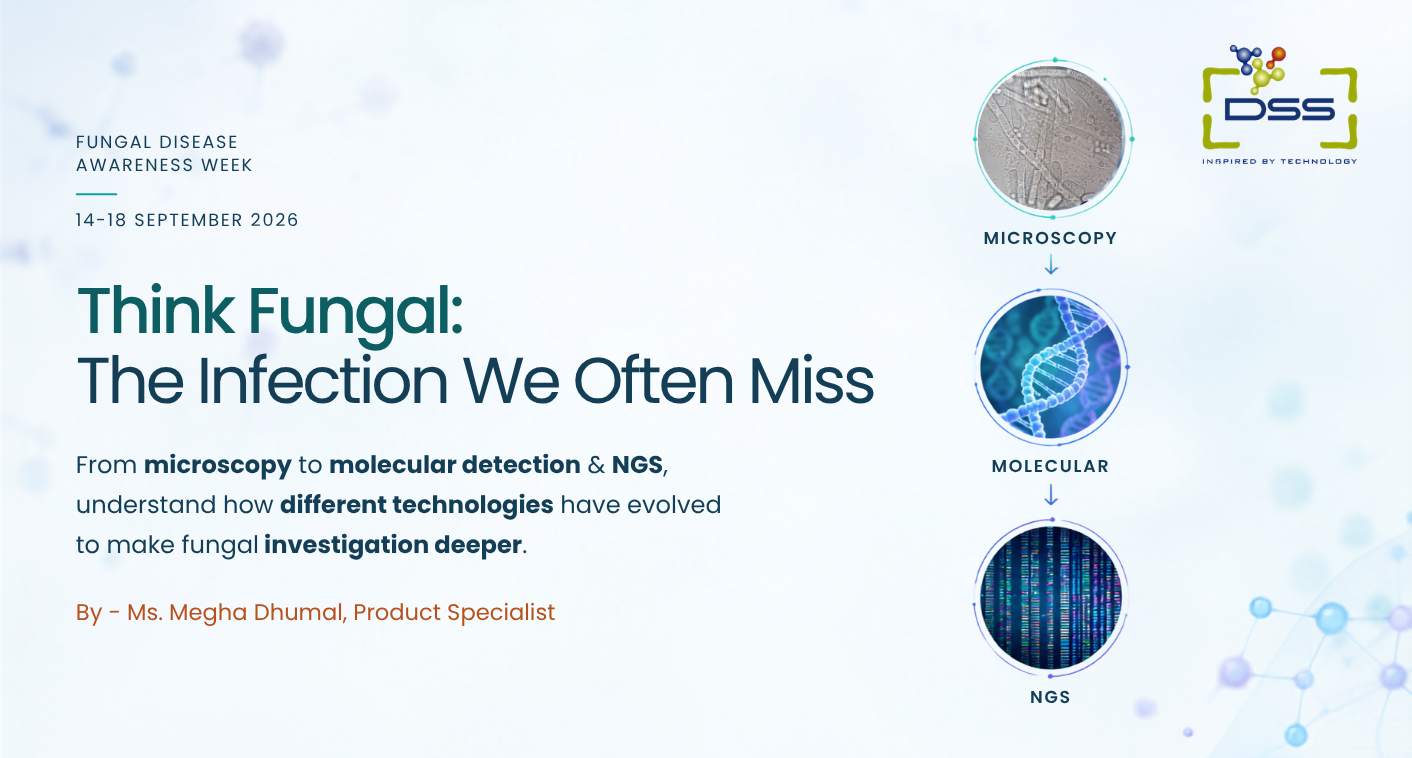
Think Fungal: The Infection We Often Miss
BY Megha Dhumal, Product Specialist 18th September 2026
Fungal Disease Awareness Week | 14–18 September 2026 2026 marks the 10th Annual Fungal Disease Awareness Week, highlighting a decade of efforts to raise awareness of fungal diseases and their...
Read More
Super-Resolution Microscopy: Upgrading to Abberior STEDYCON for Advanced Research
BY Dr. Anirban Bose (Ph.D.) Product & Application, Manager 5th September 2026
No matter how high-end your conventional fluorescence or confocal microscope is, there is a hard ceiling that eventually becomes incredibly frustrating. You could be trying to get a clear look...
Read More
How to Choose the Right Research Microscope
BY DSS Imagetech Pvt Ltd 14th August 2026
You’re standing there with a procurement form and a budget number. Someone circled in red, and down the hall a colleague is muttering that their old scope “still works fine,...
Read More