DSS: Redefining Biotechnology & Life Science in India






























How to Choose the Right Research Microscope
You’re standing there with a procurement form and a budget number. Someone circled in red, and down the hall a colleague is muttering that their old scope “still works fine, mostly.” That’s usually how this whole thing kicks off, not with some tidy checklist, but with a half-working instrument, a grant deadline breathing down your neck, and this nagging sense that picking wrong now means years of workarounds later.
Picking out a research microscope isn’t the same ballgame as buying a laptop. Messing up a laptop purchase, you’re annoyed for a week. Mess this up, and you’re the one stuck recalibrating experiments months later, tracking down weird image artifacts that have no reason to exist, or sitting across from a reviewer explaining why the resolution wasn’t enough to back up what you claimed in the paper.
This guide covers how to choose the right research microscope for a single bench or a whole shared facility, and it skips the spec-sheet theater to focus on what actually changes your results.
And if you’re specifically after a microscope for clinical research labs, most of this still applies, but there are a few extra wrinkles around regulatory compliance and sample handling that deserve their own space. We’ll get to those.
Start With the Question Nobody Asks First: What Are You Actually Imaging?
Here’s the thing. Vendors love to sell you on magnification numbers and objective lens counts. But none of that matters until you’ve answered a much more boring question: what is going on your slide?
- Fixed tissue sections? You need something different than live cell cultures.
- Fluorescently labeled proteins? You’re now in a different category of optics entirely.
- Thick, 3D organoid structures? Confocal or advanced scientific imaging capability starts becoming non-negotiable.
- Bacterial cultures for basic identification? You might not need half the bells and whistles being pitched to you.
A laboratory microscope bought without this question answered first is how labs end up with an expensive confocal system gathering dust next to a bench where nobody actually needed z-stack imaging in the first place.
Ask around. Talk to the postdocs who’ll actually be using it daily, not just the PI signing the check.
The Core Types of Research Microscopes (And Who Actually Needs Each One)
Let’s get into the actual categories, because this is usually where buyers get lost in jargon that’s really not as complicated as the marketing makes it sound.
Brightfield Microscopes
This is your workhorse. If you’re working with stained samples, standard histology, basic cell counting, routine visual checks, brightfield probably covers everything you need.
It’s also by far the cheapest option, and when budgets are tight, that matters more than people want to admit out loud.
DSS Imagetech offers a range of laboratory and research microscopes for different research and diagnostic applications.
Phase Contrast Microscopes
This one’s built for live, unstained cells. Try looking at living cells under a plain brightfield setup, and you’ll see almost nothing, just transparent, barely-there blobs drifting around in media.
Phase contrast fixes that by exploiting differences in refractive index, so you get real contrast without having to kill or stain anything.
Fluorescence Microscopes
If you’re working with GFP-tagged proteins, doing immunofluorescence, or using any kind of labeled marker, this isn’t optional, you need it.
But here’s where people get burned: fluorescence systems range wildly in quality. A cheap LED fluorescence attachment bolted onto a basic scope is nowhere near the same thing as a proper filter-cube system powered by a dedicated LED system, mercury burner or metal-halide light source.
For fluorescence-based research workflows, DSS Imagetech’s Microscopy & Imaging solutions cover advanced microscope and imaging technologies for life science research.
Confocal Microscopes
These give you optical sectioning, thin slices through thick samples without physically cutting them. If you’re working with tissue, organoids, or anything three-dimensional, confocal microscopy imaging changes what’s even possible to see.
It’s pricier, and it demands more training, but for certain research questions there’s simply no substitute.
You can explore DSS Imagetech’s scientific imaging and confocal microscopy solutions for advanced fluorescence, confocal and quantitative imaging applications.
Stereo Microscopes
Low magnification, but a genuinely 3D view with a working distance that lets you actually manipulate samples under the lens, dissection, microsurgery, that sort of thing. Not glamorous, but indispensable in the right setting.
Key Technical Factors to Actually Compare
Once you’ve narrowed down the category, this is where the real decisions happen, and you shouldn’t let a sales rep rush you past the details.
- Resolution, not just magnification: Magnification without resolution just gets you a bigger blur. Ask for the numerical aperture (NA) of the objectives, not the zoom factor a brochure loves to advertise. Higher NA usually means sharper resolution, though it often costs you working distance in return.
- Objective lens quality: Plan achromatic, plan fluorite, plan achromatic fluorite, and labels tell you how flat and color-corrected your field of view actually is. Cheap objectives fuzz out toward the edges, and that becomes a real headache the moment you’re doing anything quantitative.
- Camera and detector compatibility: If digital imaging is part of your workflow, and at this point, when isn’t it, check sensor sensitivity, dynamic range, and whether the camera plays nicely with whatever analysis software you’re already running.
- Light source stability: Flickering or uneven illumination will quietly wreck quantitative fluorescence work. LEDs have improved a lot on this front, but they’re not all built the same, so don’t assume.
- Stage precision: For time-lapse or multi-position imaging, a motorized stage with real repeatability matters way more than people expect, usually right around hour three of an experiment, when they notice the focus has drifted, and nobody caught it.
- Software ecosystem: Some proprietary software locks you into one vendor forever. Open, exportable file formats save you a ton of grief later, especially when you’re publishing, and a reviewer wants the raw data.
Budget Realities: What’s Actually Worth Paying For
Nobody has an unlimited grant. So where should the money actually go?
Spend more on optics. Spend less on flashy software add-ons you might use twice. A microscope with mediocre objectives and a beautiful touchscreen interface is a bad trade every single time.
The glass is what determines your image quality; the interface is just how you interact with that quality.
That said, don’t cheap out on the camera if quantitative analysis is central to your research. A low-dynamic-range sensor can undermine an otherwise excellent optical system, and there’s a real difference between a scope that looks fine in a demo and one that holds up under six months of daily quantitative use.
Used and Refurbished Options
Don’t ignore the used market either. Core facilities trade in scopes all the time before they’re actually worn out, budget cycles, grant renewals, whatever. So you’ll find used research-grade equipment out there that’s honestly better than some brand-new entry-level model, sometimes at half the cost. The catch: check what “refurbished” actually means. Ask if it came with recalibration. Ask about the warranty. If all they did was clean it up and slap a new sticker on, that’s not refurbishment; that’s cosmetics.
Considerations Specific to Clinical Research Labs
If you’re sourcing a microscope for clinical research labs, there’s an extra layer of complexity that a purely academic lab doesn’t usually deal with.
- Regulatory compliance. Depending on where you’re located and whether the instrument feeds into diagnostic workflows, you might need equipment that meets specific certification standards, not just research-grade gear that someone’s repurposed for clinical use.
- Sample throughput. Clinical research usually means a lot more samples moving through per day. A scope that handles five slides a week just fine in a quiet academic lab might completely choke under a clinical pipeline pushing through fifty.
- Documentation and traceability. Clinical trial data typically needs to be auditable. Look for systems with built-in logging, timestamped image capture, and secure data export, trying to bolt this on afterward is a nightmare.
- Cross-department standardization. If several departments are going to use the same model, standardizing across sites makes training simpler and cuts down on inter-operator variability messing with your results.
Clinical settings also tend to export a lot about serviceability. Downtime here isn’t just annoying; it can push back entire trial timelines. Ask vendors directly about their service response times and whether they’ll provide loaner equipment while yours is being repaired.
Common Mistakes Labs Make When Buying a Microscope
We’ve seen the same mistakes repeat across labs, year after year, so let’s name them directly.
- Buying for the experiment you’re doing today, not the ones you’ll do in three years: Research directions shift. A slightly more versatile setup now can save a second purchase later. If that is not possible to fit in the budget then at least make sure to buy a brand that will provide support for more than 5 years after the microscope line is discontinued.
- Ignoring ergonomics: Sounds trivial until someone’s spent four hours hunched over an eyepiece with a badly designed focus knob and developed genuine neck pain.
- Skipping the demo: Always request a hands-on trial with your actual samples, not the vendor’s polished demo slide. Your tissue, your stain, your conditions — not theirs.
- Underestimating training time: Confocal and advanced fluorescence systems have real learning curves. Budget training time into your rollout plan, not just the purchase price into your budget spreadsheet.
- Forgetting about maintenance contracts: A gorgeous optical system with no service plan becomes a very expensive paperweight the moment something misaligns.
Questions to Ask Before You Sign Anything
Before any purchase order goes out, run through this list with whoever’s selling you the equipment:
- What’s the actual resolution limit for the objectives included, and can I test it on my own samples first?
- What’s the warranty period, and what does it actually cover — parts, labor, or both?
- Is the software locked to this hardware, or can I export raw files freely?
- What’s the expected lifespan before major components need replacement?
- Can this system be upgraded later — new cameras, new objectives, new light sources — or is it a closed platform?
- Who handles service calls, and what’s the average turnaround time in my region?
Long-Term Care: Protecting Your Investment
A research microscope is something you commit to, not something you just buy and walk away from. Look after it properly, and it’ll keep giving you clean, dependable images for years. Ignore it, and even top-tier optics start drifting out of alignment way sooner than anyone expects.
Environmental Control Matters More Than People Realize
Dust, humidity swings, vibration from nearby equipment like centrifuges, foot traffic, HVAC systems, all of it chips away at image quality over time.
If you can swing it, dedicate a stable, low-traffic room to anything doing sensitive fluorescence or confocal work.
Routine Cleaning Isn’t Optional
Cleaning isn’t a skip-if-busy task, either. Objective lenses are constantly picking up oil smudges, dust, and stray fingerprints; you often won’t even notice it happening in the moment.
Wiping them down properly after each session is what keeps that residue from piling up into something that eventually needs a technician and a bill you didn’t plan for.
Calibration Schedules Need to Be Written Down Somewhere, Not Just Remembered
Put someone on the team in charge of an actual calibration calendar.
This is exactly the kind of task that gets quietly skipped right when it matters most, usually right before a big imaging push ahead of a paper deadline.
Log Usage and Issues as They Come Up
Even something as simple as a shared logbook, paper or digital, helps you catch small problems before they snowball.
If three different people happen to mention the focus feels “sticky” in the same month, that’s a pattern worth acting on, not ignoring until it turns into a full-blown breakdown.
Labs that make these habits part of their everyday routine tend to squeeze a lot more usable life out of the same equipment than labs that just treat the microscope as a fixture and never think about it again.
Bringing It All Together
Picking the right instrument really comes down to one thing: matching the tool to your actual science, not chasing whatever looks most impressive on paper.
A brightfield scope that’s reliable and properly maintained will beat a fancy confocal system that nobody on your team really knows how to run.
Start with your sample type, get the optics sorted before anything else, and don’t let a slick sales pitch pull your attention away from the questions that actually matter five years down the line.
Talk to the people who’ll actually be sitting at the eyepiece every day, not just the PI signing off on the purchase order. Run your own samples through it before you commit to anything. And at the end of the day, the best research microscope for your lab isn’t the one with the longest spec sheet. It’s the one that fits how your team actually works, day after day, experiment after experiment.
FAQ’s
1. How much should a research microscope cost?
It really depends on the category. A solid brightfield or phase contrast system can run anywhere from a few thousand dollars up to the low tens of thousands, while a fully loaded confocal setup with automation can easily push into six figures.
Get quotes from at least three vendors before you commit to anything, pricing varies more than you’d expect, even between systems with nearly identical specs.
2. Can one microscope handle multiple imaging modalities?
With proper maintenance, the mechanical and optical parts can easily hold up for fifteen years or more. It’s the electronics, cameras, and software that tend to show their age first, you’ll likely be upgrading those well before the core optics ever need replacing.
3. How long does a research-grade microscope typically last?
With proper maintenance, the mechanical and optical components can remain functional for fifteen years or more. Electronics, cameras, and software tend to age faster and may need upgrading well before the core optics do.
4. Is it better to buy from a single vendor for an entire facility?
Standardizing on one vendor across a shared facility simplifies training, spare parts, and service contracts. But it can also limit flexibility if that vendor’s newer models don’t fit every research group’s needs.
Weigh consistency against adaptability based on how diverse your facility’s projects actually are.
Latest Articles

Think Fungal: The Infection We Often Miss
BY Megha Dhumal, Product Specialist 18th September 2026
Fungal Disease Awareness Week | 14–18 September 2026 2026 marks the 10th Annual Fungal Disease Awareness Week, highlighting a decade of efforts to raise awareness of fungal diseases and their...
Read More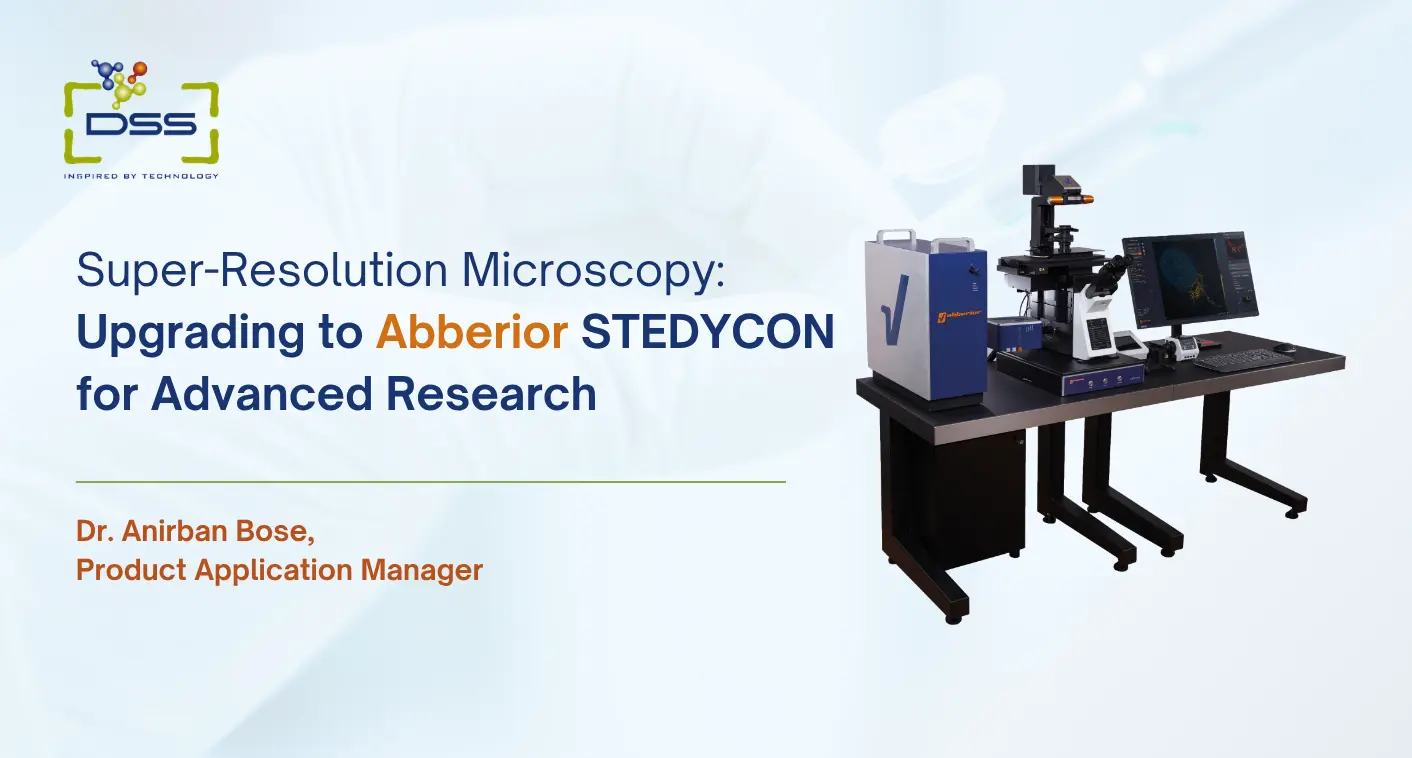
Super-Resolution Microscopy: Upgrading to Abberior STEDYCON for Advanced Research
BY Dr. Anirban Bose (Ph.D.) Product & Application, Manager 5th September 2026
No matter how high-end your conventional fluorescence or confocal microscope is, there is a hard ceiling that eventually becomes incredibly frustrating. You could be trying to get a clear look...
Read More
How to Choose the Right Research Microscope
BY DSS Imagetech Pvt Ltd 14th August 2026
You’re standing there with a procurement form and a budget number. Someone circled in red, and down the hall a colleague is muttering that their old scope “still works fine,...
Read More