DSS: Redefining Biotechnology & Life Science in India































WHY MLPA (MULTIPLEX LIGATION DEPENDENT PROBE AMPLIFICATION)?
MLPA is stands for multiplex ligation dependent probe amplification developed by MRC HOLLAND in 2002. It is PCR based technique which help to detect CNV (copy number variation) up to 60 DNA sequence in a single reaction with only single primer pair. MLPA utilize 40-60 probe each target specific DNA sequence. It’s not only detected small chromosomal abnormalities (deletions or duplications), known point mutation and SNPs but also determine methylation status of promoter.
WHAT IS MLPA PROBE?
It is a hybridization probe of single stranded DNA which consists of two parts LPO (left probe oligonucleotide) and RPO (right probe oligonucleotide). LPO have forward PCR primer and DNA hybridisation sequence. RPO have reverse PCR primer and DNA hybridisation sequence with additional stuffer sequence to modulate the length. Each probe in MLPA have unique length so that they can identified in amplification process.
HOW DOES MLPA WORK?
MLPA methods consist of following methods-
- DENATURATION– The sample DNA is denatured by heating it resulting in single stranded sample DNA.
- HYBRIDISATION -Pairs of probes i.e., LPO AND RPO bind with the sample DNA.
- LIGATION– Thermostable ligase is applied to the hybridised DNA so that pair of probe gets joined.
- AMPLIFICATION– All successfully ligated DNA are amplified by PCR using florescent labelled PCR primer.
- FRAGMENT SEPRATION– PCR product is separated by length using capillary electrophoresis which are compared with size standard which act as a molecular ruler.
- DATA ANALYSIS-Analysis is done by Coffalyser.net which is a free MLPA analysis software developed BY MRC-Holland. Coffalyser.net take raw data and give robust result by comparing each test sample with the set of reference sample.
APPLICATION OF MLPA-
1.MLPA for first line screening-
DMD (DUCHENNE MUSCULAR DYSTROPHY)- It is X linked disease affecting more males than females caused by mutation of DMD gene. DMD gene duplication cannot be detected by PCR. MLPA ASSAY Is a first-choice method used for detecting heterozygous deletion or duplication. Approx. 70% DMD are identified with MLPA probe P034-P035.
SMA(SPINAL MUSCULAR DYSTROPHY)- It is autosomal recessive trait .SMA is neuromuscular disease which led to symmetric proximal muscle weakness due to degeneration of the anterior horn cells of the spinal cord. It is caused by deletion of SMN1 gene. With the help of MLPA SMN1 gene can be differentiated with SMN2 gene which is similar to SMN1. MLPA probe P021 SMA and P060 SMA screening is performed.
2.MLPA IN TUMORE PROFILING– In ovarian cancer, MLPA PROBE P002, BRCA1 AND P045 BRCA2 are used to identify deletion and duplication associated with ovarian cancer. And also MLPA probe to detect methylation status and point mutation in cancer patient.
MLPA have variety of other applications like –
- Prenatal diagnosis of chromosomal abnormalities.
- Genome mutation detection and mutation.
- Epigenetic biomarker for disease diagnosis.
- Diagnose molecular and genomic methodology for haematologist.
- Advances in hemoglobinopathy detection etc.
SO, THE QUESTION IS WHY MLPA?
Recently, it is found that MLPA assay became most widely used technique for detecting genetic diseases. Because of its high throughput and low input, gives result within 24hrs which saves our time. It also cut off cost by minimising the use of variety of primer. Highly sensitive and accurate tool for detecting copy number changes and require very less amount of DNA sample up to 50ng.MLPA have several advantages over other available technique like the use of MLPA to detect CNVs offers several advantages over other available techniques such as Southern Blot and FISH i.e.
- it discriminates two sequence which differ by a single nucleotide.
- Identify single gene aberrations which is not detected by other technique.
- Characterize specific breakpoint site of gene.
So, large application of this approach is the result of a number of advantages provided by MLPA assay when compared to other techniques.
Latest Articles

How to Choose the Right Research Microscope
BY DSS Imagetech Pvt Ltd 14th August 2026
You’re standing there with a procurement form and a budget number. Someone circled in red, and down the hall a colleague is muttering that their old scope “still works fine,...
Read More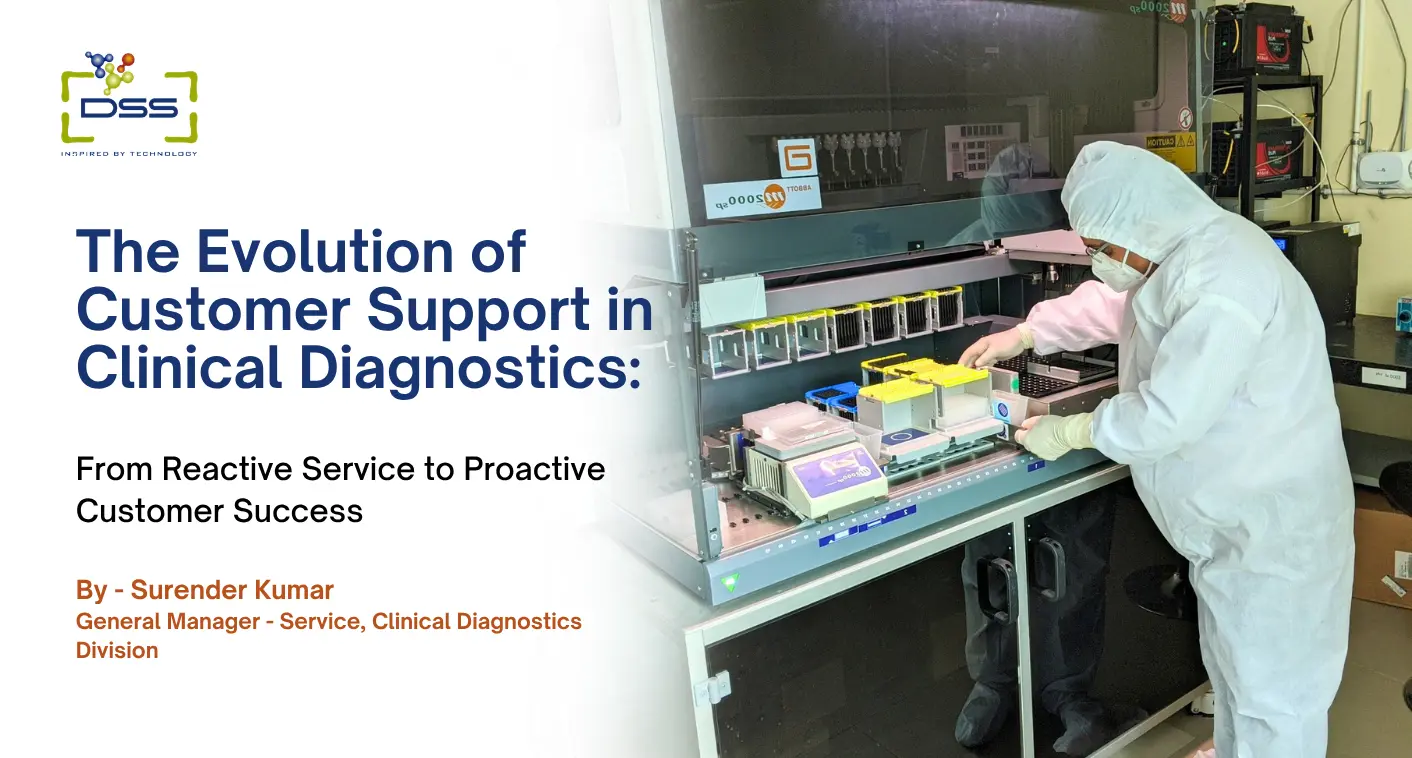
The Evolution of Customer Support in Clinical Diagnostics
BY Surender Kumar | General Manager – Service, Clinical Diagnostics Division 23rd July 2026
How Customer Expectations Have Changed Over the Last 20 Years “Customer Support is no longer a cost center—it is a competitive advantage.” Twenty years ago, customer support was primarily viewed...
Read More
The ROI of Lab Automation: How Automated Karyotyping Reduces Costs...
BY DSS Imagetech 13th July 2026
If you walk into almost any cytogenetics lab across India right now, you’ll probably hear the exact same complaint. Lab directors are staring at their monthly numbers, calculating just how...
Read More